AFUE Explained: 80% vs 95% Furnaces and When the Upgrade Makes Sense
Think of AFUE as the share of every dollar of gas that ends up warming your house instead of going up the flue.
October 16, 2026 · 4 min read
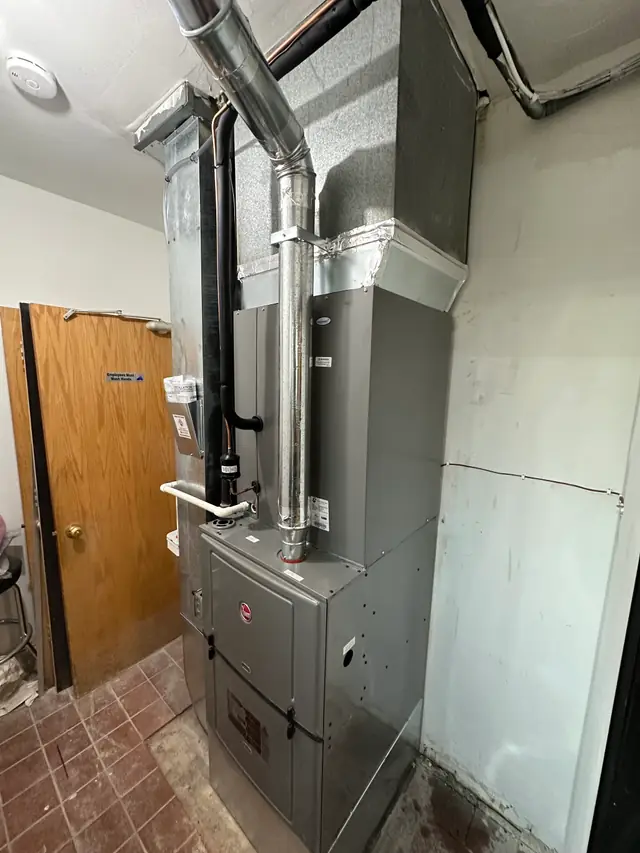
Every gas furnace carries an AFUE rating, and it is one of the most useful numbers on the spec sheet once you know what it means. Around Joliet, Lockport and Plainfield, where the heat runs hard from November into March, it is worth a few minutes of your attention before you replace anything.
What AFUE actually measures
AFUE stands for annual fuel utilization efficiency. It is the percentage of the gas a furnace consumes that gets turned into heat for your home. An 80% AFUE furnace uses 80% of the gas energy it consumes and turns it into heat. The other 20% leaves with the exhaust.
A high-efficiency gas furnace sits at 90% AFUE or higher, with the top models reaching 98.5%. So the question is simple: out of every 100 units of gas you pay for, how many warm the house, and how many go outside?
- At 80% AFUE, about 80 of every 100 units become heat and about 20 are lost.
- At 90% AFUE, about 90 become heat and about 10 are lost.
- At 95% AFUE, about 95 become heat and about 5 are lost.
Going from 80% to 95% does not sound dramatic, but look at the waste. You cut the lost share from 20 down to 5, which is a quarter of what you were throwing away before.
Why the high-efficiency ones look different
A standard 80% furnace sends hot exhaust up a metal flue, often through a chimney. A high-efficiency unit pulls so much heat out of the exhaust that what is left is cool enough to vent through white PVC pipe out a side wall. You can usually spot one by that white plastic pipe. It also produces water as a byproduct, so it has a drain for condensate that needs to run somewhere sensible, like a floor drain or a condensate pump.
That is why swapping an 80% furnace for a 95% one is not always a like-for-like job. The venting, the drain and sometimes the combustion air supply all change. In an older basement in Orland Park or Palos Hills, that can mean routing new pipe through joists or walls, and it is worth asking about before you agree to anything.
When the upgrade tends to pay off
Efficiency pays you back in proportion to how much heat you buy. Chicagoland has long, cold winters, with real stretches where the furnace runs most of the day. That is a good setting for a high-AFUE unit, because there are plenty of hours for the saved gas to add up. Nobody can promise you a payback date without looking at your house, your usage and current gas rates, so be wary of anyone who does. But the logic is sound: more heating hours and a bigger lost share mean more to gain.
- Your current furnace is an old 80% unit or lower, and you are heating a larger or leaky house all winter.
- You plan to stay put for many years, which gives the efficiency time to matter.
- The furnace is already due for repairs, so you are comparing a repair to a replacement anyway.
- Your house is reasonably well sealed and insulated. A better furnace cannot fix heat pouring out of an attic.
When an 80% furnace is still a fair choice
If the home is small, the winter heating bill is modest, or the venting for a high-efficiency unit would be awkward and expensive to rework, an 80% furnace installed well can be a sensible choice. The wrong move is paying for a premium unit and then ignoring the basics. Furnaces lose real efficiency to dirty burners, clogged filters and weak airflow, and a neglected 95% unit can run worse than a well-kept 80%.
Questions worth asking before you decide
- What AFUE is the proposed furnace, and what is the one I have now?
- Will the venting change, and where will the condensate drain?
- Is the new furnace sized for my house, not just matched to the old one?
- What do the ducts look like, and does the airflow work for this model?
- What is the yearly maintenance plan for it?
Pay attention to how the person answers. A good tech will tell you plainly when a cheaper repair makes sense. One Climaxx customer wrote that Justin did not try to sell him on replacing the entire unit just to make money, and that kind of honesty is exactly what you want at your front door in January.
Keep it running, whatever you choose
Whichever AFUE you land on, the number is a ceiling, not a promise. Yearly maintenance is what keeps a furnace near that ceiling. Burners get cleaned, the heat exchanger and flue get checked, filters get replaced, and small problems get caught in October instead of at two in the morning during a cold snap.
If you are weighing a repair against a replacement, or you just want to know what AFUE your current furnace is, Climaxx Heating & Cooling can take a look. We cover Frankfort, Mokena, Tinley Park and the surrounding towns. Call (708) 717-2772, any hour, day or night.
Climaxx Heating & Cooling, (708) 717-2772
Call (708) 717-2772More articles
What SEER Actually Means When You Replace an AC in the Southwest Suburbs
A plain-English look at the efficiency number on the sticker, and how much of it your house will ever use.
Is Your Old Boiler Worth Keeping? Reading Efficiency by Age
Boilers can run for decades, but efficiency slips with age. Here is how to read where yours stands.