Is Your Old Boiler Worth Keeping? Reading Efficiency by Age
Boilers can run for decades, but efficiency slips with age. Here is how to read where yours stands.
October 16, 2026 · 4 min read
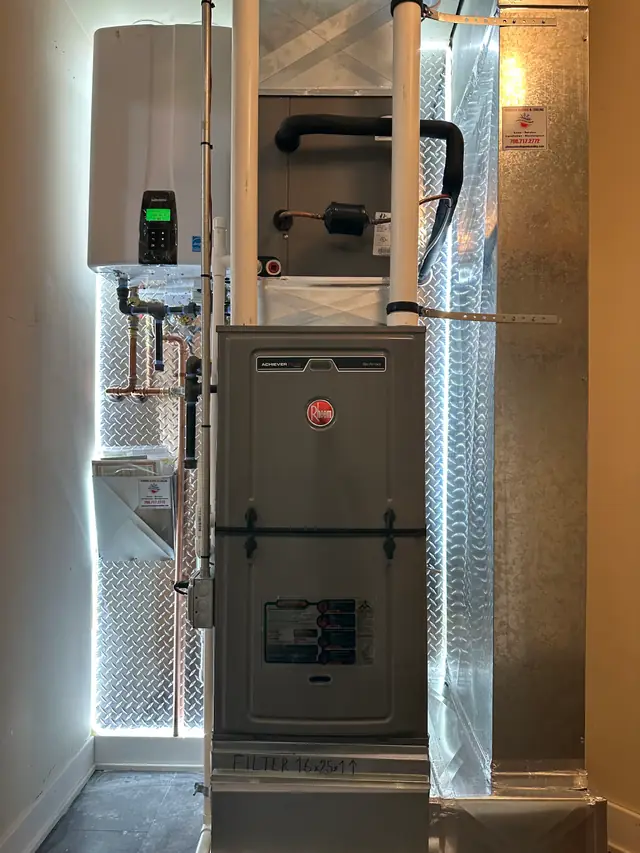
Plenty of older homes in Lemont, Palos Park, Lockport and the older neighborhoods of Joliet heat with a boiler. Radiators or baseboard, that steady warmth, no blowing air. Boilers are tough, and a lot of them outlast the furnaces next door. But tough is not the same as efficient, and an old boiler can quietly burn through more fuel than you would guess.
How efficiency drops with age
Climaxx publishes a simple guide on its boiler page that gives a feel for how efficiency changes as a boiler gets older. Think of it as a rule of thumb, not a lab result, because every boiler and every install is a little different.
- Over 25 years old: roughly 60 to 70% efficient.
- About 20 years old: roughly 75% efficient.
- About 15 years old: roughly 80 to 85% efficient.
- 10 or more years old: roughly 80 to 85% efficient.
Read that as a share of your fuel that becomes heat. A boiler sitting at 65% is sending about a third of what you pay for out the flue. A boiler at 80 to 85% is losing a lot less. Same house, same radiators, noticeably different appetite.
Maintenance moves the number too
The same guide makes a point that is easy to skip over: yearly maintenance, cleaning and checks play a big role in efficiency. That matters because two boilers of the same age can perform very differently. One has been cleaned and tuned every fall. The other has gone untouched since the previous owner. Soot on heat-transfer surfaces, a fouled burner, scale inside the system and a poorly adjusted flame all drag efficiency down, and you cannot see any of it from the basement stairs.
Signs your boiler is telling you something
Efficiency is only one part of the story. Watch for the behavior that tends to show up as a boiler reaches the end of its useful life.
- Rising fuel use with no change in how you live or how cold the winter was.
- Repeated service calls for the same kind of problem.
- Rust, drips or mineral crust around the boiler, fittings or piping.
- Banging, gurgling or kettle-like sounds from the unit.
- Radiators that stay cold on one side of the house, or a house that takes much longer to warm up than it used to.
- Uneven heat from room to room even after bleeding radiators.
One of these on its own may be a simple fix. Several together, on a boiler past 20 years old, are a good reason to start a real conversation about the future.
Keep it, repair it, or replace it
Here is a straightforward way to think about it. If your boiler is younger, has been looked after and is running fine, keep servicing it and enjoy the heat. If it is in the middle years and starting to show wear, a service visit will tell you what condition it is really in, and a good tech will say so plainly if a repair makes sense. If it is past 25 years, the efficiency numbers above, a history of repairs and the age of the parts all tilt toward planning for a replacement before it fails on the coldest night of the year.
That last part is the real cost of waiting. A planned replacement lets you compare options, pick a time and have the work done calmly. An emergency replacement in a January cold snap happens on the boiler's schedule, not yours. A boiler that dies at 2 a.m. in a house with old plumbing can also put pipes at risk once the house cools down enough.
Do not forget the rest of the system
Boilers do not work alone. Piping, circulator pumps, radiators and baseboard all affect how well heat gets from the basement to the living room. Climaxx also handles piping work, including leaky and rotten water pipes, and custom sheet metal. When an older system gets looked at, it is worth walking the whole loop, not just the box in the corner. A new boiler hooked up to tired piping will not give you everything it could.
What to do this fall
- Find the age of your boiler. The data plate on the unit usually has a serial number you can look up with the manufacturer.
- Think back over the last few winters. Any service calls, odd noises or cold rooms?
- Book a cleaning and check before the first hard freeze, not after.
- If it is past 20 years old, ask for an honest read on the condition and what a replacement would involve, so you know your options.
If you are not sure where your boiler stands, Climaxx Heating & Cooling services boilers across Homer Glen, New Lenox, Romeoville and the rest of the southwest suburbs: maintenance, repairs, installation and sales. Call (708) 717-2772, any hour, and we will help you figure out the next step.
Climaxx Heating & Cooling, (708) 717-2772
Call (708) 717-2772More articles
What SEER Actually Means When You Replace an AC in the Southwest Suburbs
A plain-English look at the efficiency number on the sticker, and how much of it your house will ever use.
AFUE Explained: 80% vs 95% Furnaces and When the Upgrade Makes Sense
Think of AFUE as the share of every dollar of gas that ends up warming your house instead of going up the flue.