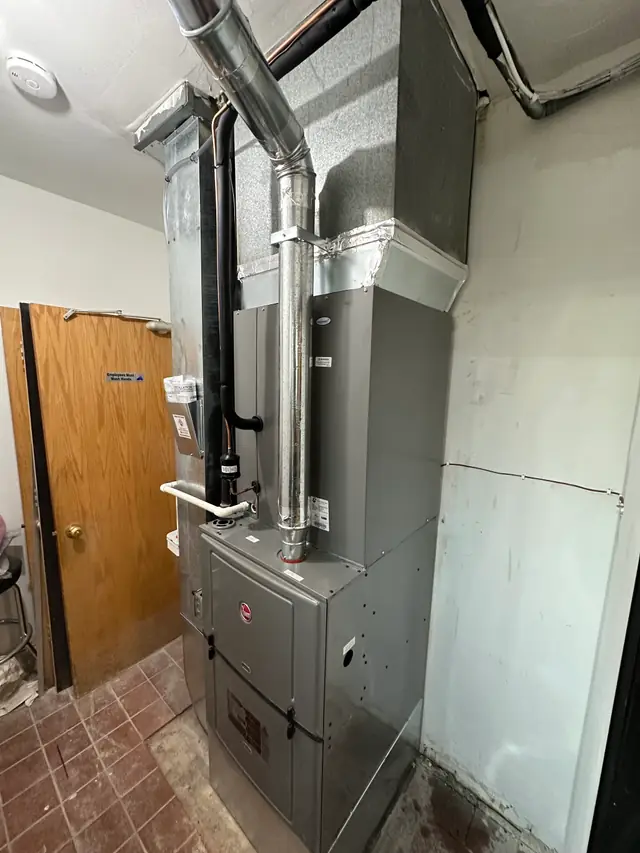
No heat, a clicking igniter, or a furnace that shuts itself off
Most furnace calls come down to a short list: the burners never light, they light and then quit after a few seconds, the blower runs but the air stays cold, or the furnace cycles off on a safety limit before the house warms up. A cracked igniter, a dirty flame sensor, a failing blower motor and a restricted flue all produce a cold house, but each one has its own fix. That is why we diagnose before we replace anything.
A gas furnace runs a sequence every cycle: the inducer starts, a pressure switch proves draft, the igniter glows, the gas valve opens and the flame sensor confirms fire. Where the sequence stops tells a tech which part to chase. A flame sensor coated with residue shuts the gas right after ignition, and a limit switch that keeps tripping usually points to poor airflow, such as a clogged filter or a weak blower, rather than a bad switch.
Furnaces fail on the coldest nights, so the Climaxx line stays open 24 hours a day, 7 days a week, at (708) 717-2772. We work in Joliet, Plainfield, Romeoville, Lemont, Palos Park and the rest of the southwest suburbs from our base in Homer Glen. Call, tell us what the furnace does when you set the thermostat, and we will work out the next step with you over the phone.
AFUE explained: what 80% and 98.5% actually mean
AFUE is the efficiency rating printed on every gas furnace, and it is simpler than it sounds. An 80% AFUE furnace uses 80% of the gas energy it consumes and turns it into heat. The remaining 20% leaves through the flue as exhaust. The number is a percentage of the fuel you pay for that ends up warming your rooms, so a higher AFUE means less of your gas bill goes up the chimney.
A high-efficiency gas furnace has an AFUE of 90% or higher, up to a maximum of 98.5% AFUE. These units pull extra heat out of the exhaust before it leaves the house, which is why they run cooler at the vent and are built differently from an 80% furnace. The jump from 80% to 95% is fifteen more points of the gas energy turning into heat inside your home instead of outside it.
None of this means the highest number is right for every house. An older furnace that still runs safely and gets its yearly service may have years left, and the right moment to step up is usually when repairs begin to pile up or when the unit is due for replacement anyway. Climaxx will give you the AFUE comparison for your own situation, without pushing you toward more equipment than the house needs.
Yearly clean and check, honest sizing, and how a new furnace goes in
Furnace maintenance is a yearly clean and check done before the cold arrives. The tech cleans the burners and flame sensor, inspects the heat exchanger, tests the igniter and safety switches, checks the blower, changes or inspects the filter and looks over the venting. It is a small visit compared with a no-heat emergency in January, and it is the best way to catch a worn part while it is still a scheduled job.
When a furnace does need replacing, sizing is where a good install starts. The new unit should match the heating needs of the house and the ductwork it feeds, not just the nameplate of the one coming out. High-efficiency furnaces also vent differently: they exhaust through PVC pipe instead of a metal flue and drain condensate, so the install includes new venting and a proper drain path.
A customer wrote that Climaxx installed a new furnace and A/C quickly and with no issues, which is how we want every install to read. We offer furnace maintenance, repairs, installation and sales, so one call covers the whole life of the equipment. If you are comparing options in Orland Park, Mokena or Frankfort, ask about the furnaces we sell when you phone.